Steel vs. PET/Composite Strapping: Warehouse Transition Guide

Eco-Friendly Composite Cord Strap Systems & Reusable Tools
December 17, 2025
Composite Cord Strap Supplier in Maharashtra
January 10, 2026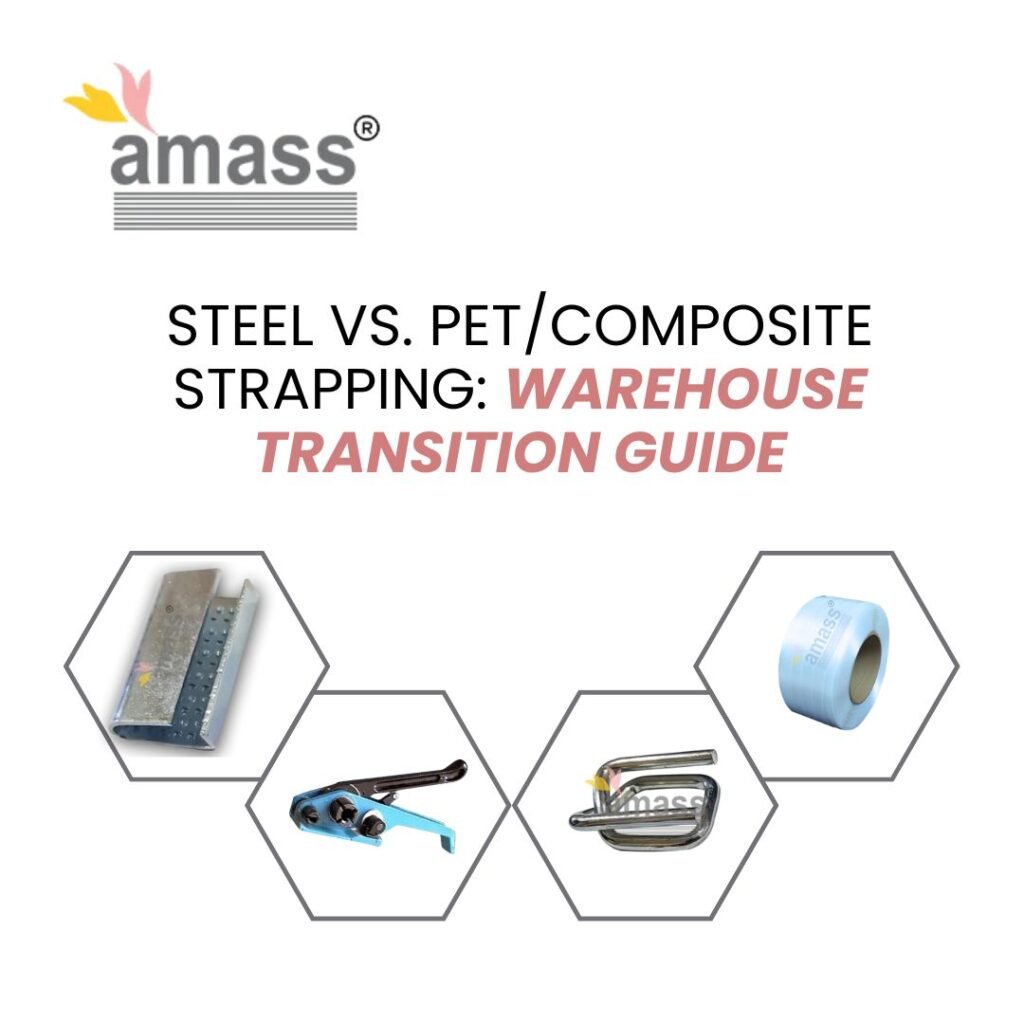
Steel strapping have run for a long time in Indian warehouses despite its major problems. Injuries from sharp edges and recoil, rust stains on finished goods, downtime from tool breakages, and higher per-pallet costs. All of which would cost the owner. All because there was no alternative to its effect. Not until now. PET and composite strapping made its way as a great alternative to this.
This guide shows you how steel, PET, and composite really behave on the floor, where each belongs, and how to run a controlled switch that cuts risk and improves throughput.
How steel, PET and composite perform in real warehouse conditions
Strength and shock absorption
Steel has high tensile strength but almost zero elongation, which means it can snap under sudden shock or snagging during handling. PET offers controlled elongation—typically around 10–15%—which absorbs impacts and keeps tension over time. Composite strapping, built from bundles of polyester fibers, mimics steel’s high strength while adding the shock-absorption benefits of synthetic materials.
Field testing shows that PET and composite often deliver higher system strength in actual joints compared to what you get from steel joints on the same loads, because the joint design and material behavior work together more predictably.
Safety and operator fatigue
Steel recoil after cutting has caused documented injuries in busy dispatch zones. Sharp cut ends slice gloves and skin, and heavy steel coils strain backs and shoulders. PET and composite eliminate recoil risk, weigh far less per roll, and do not create sharp edges when cut.
One pattern in multi-location operations is simple: sites that switched to PET or composite see fewer strapping-related first-aid cases and faster shift throughput because workers handle tools and materials with less fatigue.
Rust, staining and environmental durability
Steel corrodes in humid environments, stains cartons and finished surfaces, and weakens over time in outdoor or coastal storage. PET and composite do not rust, resist UV degradation, and maintain strength across wide temperature ranges common in India. That difference matters when pallets sit in open yards or travel through monsoon regions before reaching customers.
True cost beyond the price tag
Material and tooling expenses
Steel often looks cheaper per kilogram on a purchase order, but that view ignores tool complexity, spare parts, and maintenance. Steel tools need frequent servicing, seals wear quickly, and tensioners break under heavy use. PET and composite tools—especially battery-powered models—run longer between service intervals and have fewer moving parts.
When you calculate cost per strapped unit instead of cost per roll, many warehouses find that PET and composite match or beat steel, especially on automated or semi-automated lines.
Hidden losses from injuries and damage
A surprising insight from warehouse audits: injury claims and product damage from steel strapping often cost more over a year than any strap material price difference. Rust transfer ruins carton prints, recoil injuries trigger compensation and training reviews, and steel scrap disposal adds waste handling costs.
Switching to PET or composite closes those loss buckets while improving line speed, which directly affects how many pallets you can turn per shift.
Where steel still fits—and where it does not
Legitimate steel applications
Steel makes sense for a narrow set of loads:
- Extremely dense, non-compressible items like some metal billets where zero elongation is critical
- Niche processes with legacy customer specifications that contractually demand steel
If your load does not fit one of those two categories, steel is likely a habit, not a requirement.
Habit-driven steel use
Many warehouses still strap timber bundles, bricks, coils, drums, and mixed pallets with steel because “that is how it was done before.” Performance data from controlled tests shows PET and composite match or exceed steel on those exact loads while cutting injury risk and improving handling speed.
If you cannot point to a specific technical reason steel is needed, you are probably overpaying for outdated practice.
PET strapping for pallets and unitizing
How PET works in high-volume lines
PET handles mixed-SKU pallets, carton stacks, and moderately heavy packs efficiently. Machine-grade PET runs on automatic arch systems, while hand-grade PET works with battery or pneumatic tools for lower volumes. Friction-welded joints from quality battery tools can reach 80–90% of strap break strength, which rivals or beats many steel seal joints in real-world conditions.
Warehouses report faster strapping cycles and fewer re-dos when using PET on standard pallet formats, partly because the material behavior is more forgiving of small operator variations.
Composite strapping as synthetic steel
Construction and system strength
Composite strapping uses bundles of high-tenacity polyester fibers with protective coatings, paired with steel buckles to create friction-based joints. This design delivers high, repeatable system strength comparable to steel strapping but without rust, sharp edges, or heavy tool wear.
Where composite excels
Composite is the best option for heavy, irregular loads like machinery, pipes, timber bundles, and steel coils stored or dispatched from warehouses. It also offers re-tensioning capability and causes less damage to product edges and finishes than hard steel bands. In side-by-side trials, composite often outperforms steel on vibration and shock resistance while weighing far less and needing simpler tools.
Transition roadmap: switching from steel
Step 1: Map and audit current usage
List every load type you currently strap with steel: weight, dimensions, SKU mix, destination, and incident history. Separate “must-have steel” loads from “habit steel” loads based on technical need, not tradition.
Step 2: Run controlled pilot trials
Pick 3–5 representative load types and strap them with PET or composite using matched tools and joints. Measure strap consumption, cycle time, joint integrity, product damage, and worker feedback over at least two weeks. Compare those results directly to your steel baseline, not to supplier brochures.
Step 3: Update tools, training and SOPs
Select complete systems—strap, joint hardware, and tool—not separate components. Train operators on new tensioning and sealing methods, update work instructions, and revise tool maintenance schedules. PET and composite tools behave differently from steel tools, so skipping this step wastes the material upgrade.
Step 4: Scale and decommission steel
Roll out PET or composite by zone or line based on pilot data. Consolidate SKUs, phase down steel inventory in a controlled sequence, and track injury rates, throughput, and total cost per strapped unit over the first quarter.
Common questions on the switch
Will PET or composite really hold our heavy loads?
Yes, if you design the system correctly. Many PET and composite configurations exceed the working strength of common steel sizes when joint efficiency and elongation behavior are factored in. The key is matching strap width, grade, and joint type to the actual load, not guessing.
Do we need to replace all our tools?
Most likely, yes. Steel tools are not compatible with PET or composite materials. Budget for battery or pneumatic PET tools and manual or pneumatic composite tools as part of the transition cost. Tool investment typically pays back within months through lower injury costs and faster strapping cycles.
Can we run steel and PET side by side during transition?
You can, but it creates confusion and slows adoption. A phased, zone-by-zone rollout with clear cutover dates works better than indefinite parallel operations.
Take the next step
Steel strapping made sense twenty years ago. Today, PET and composite deliver better performance, lower total cost, and safer operations for most warehouse loads. If you are ready to move past habits and upgrade your strapping system, take action now.
At Amass Strap, the approach is straightforward: engineers complete PET and composite systems around your specific loads, support on-site trials with data you can trust, and provide the tools and training to make the switch stick. Contact Amass Strap today to audit your current steel usage and design a transition plan tailored to your warehouse operations and throughput goals.